The Museum of HP Calculators
The Museum of HP Calculators
This page provides information primarily of interest to HP calculator collectors.
Topics are:
Difficulty Of Obtaining Various Models (And Prices)
Series Names
Code Names
Variations and Special Models
Battery Packs & Chargers
Decoding Serial Numbers
Earliest Serial Numbers (so far)
How To Build A Limited Collection
Where To Find Them
How To Buy Them (Remotely)
Where To Get Supplies
The following guide groups calculators into broad categories based on the difficulty of obtaining. (This is mostly a matter of how hard they are to find, but more difficult models tend to cost more especially if purchased from a collector or dealer.) The difficulty ratings are for working models in extra fine to new condition.
By popular demand, price ranges recently observed have been added. Take these prices with a grain of salt however as some of them are based on a single sample and all of them are based on less than ten. These prices are for public sales between collectors typically advertised on the Internet. All prices are for calculators described as being in at least "very good" condition and working.
These price ranges do not include the bargains you can find in flea markets, government and business liquidation sales or by trolling regional for sale groups. Cheap HPs can be found if you're willing to spend the time. Generally, calculators at the high end of the price ranges were sold via "best offer" advertisements on the net or in online auctions such as eBay.
Price range decoder:
| Model | Difficulty | Price Range (see above) |
| HP-01 |  (1) (1) |
$1100, $1325, $2000 |
| HP-01 |  (incomplete) (incomplete) |
$625, $760 |
| HP-10 | |
$250, $305, $400 |
| HP-10C | (2) |
$102-$261, $400 |
| HP-11C |  |
$46, $77, 90-$117, $152, $157 |
| HP-14B | |
|
| HP-15C |  |
$96-$199, $247, $323(6) |
| HP-16C | |
$30, $71-$260, $280, $301, $480(6) |
| HP-17B | |
$26-$38 |
| HP-18C | |
$50, $60 |
| HP-19B | |
|
| HP-19C |  |
$100-$410 |
| HP-21 | |
$16-$110 |
| HP-21S | |
|
| HP-22 |  |
$50-$162 |
| HP-22S | |
$75 |
| HP-25 | |
$35-$140, $202 |
| HP-25C | |
$75 |
| HP-27 | |
$70-$90, $270, $355 |
| HP-27S | |
$32 |
| HP-28C | |
$35-$50, $128 |
| HP-28S | |
$45-$66, $114 |
| HP-29C | |
$143-$232, $365, $475 |
| HP-31E | (2) |
$50-$128 |
| HP-32E | |
$25-$45, $113, $155 |
| HP-32S | |
$30, $40, $75 |
| HP-33E | |
$30-$68, $91 |
| HP-33C |  |
$50-$186 |
| HP-34C | |
$46-$150, $177, $202, $205 |
| HP-35 | (most types) |
$71-$186 |
| HP-35 | (all legends on keys) |
$100 |
| HP-35 | (red dot) (7) |
$300, $600 |
| HP-37E | |
$40, $60 |
| HP-38C | |
$117 |
| HP-38E | |
$41, $99 |
| HP-41C | (3) |
$40-$90 |
| HP-41C | (option 001/blank) |
$101-112, $200 |
| HP-41CV | (3) |
$65-$91, $125, $135 |
| HP-41CX | (3) |
$85-$127, $180, $200, $230, $280 |
| HP-42S | (3) |
$95-$202 |
| HP-45 | |
$50, 63-$123, $180, $346(6) |
| HP-46 | |
$167, $197-$250 |
| HP-48S | |
$35, $57 |
| HP-48SX | |
$50-$80 |
| HP-55 | |
$75-$110, $127, $203, $228 |
| HP-65 | |
$96-$352, $450 |
| HP-67 | |
$92-$225, $315, $352, $450 |
| HP-70 | |
$285, $447 |
| HP-71B | |
$35-$110 |
| HP-75C | (5) |
$3-$50, $100 |
| HP-75D | (5) |
$3-$35, $130 |
| HP-80 | |
$97-$160, $204, $238, $385 |
| HP-81 | |
|
| HP-83 | |
$90 |
| HP-85 | |
$53, $100 |
| HP-86 | |
|
| HP-87 | |
$60 |
| HP-91 | |
$200, $289 |
| HP-92 | |
$275 |
| HP-94 | (4) |
$105, $250, $300, $325 |
| HP-95C |  |
|
| HP-97 | |
$76-$202, $227 |
| HP-97S | |
$200, $275, $300 |
| HP-9100 | |
$750, $800, $1225 |
| HP-9805 | |
$150, $360, $413 |
| HP-9810 | |
|
| HP-9815 | |
$100, $150, $256 |
| HP-9820 | |
$200, $300 |
| HP-9825 | |
$30, $67, $150 |
| HP-9830 | |
$100, $270, $280 |
Notes:
(1) The HP-01 is not really as rare as most other
Extremely Difficult and even some Very Difficult models but everyone knows
it's a great collectible so it's very hard to obtain. The "incomplete" entry
refers to a sample missing, any of the following: pen stylus, clasp stylus.
(Several less-than-excellent samples have sold recently in the $300-$800
range.)
(2) Some low end models like the HP-10C and HP-31E are hard to find as they tend to get thrown away. The good news that you can sometimes get them for throw-away prices. The $400 HP-10C was described by the seller as "new in the box".
(3) HP-41s were very popular and therefore very common. However, their popularity persists among some users so don't be surprised if some owners refuse to sell at any price. The recently discontinued HP-42S also has fans that will pay very high prices.
(4) If you really want to impress your collecting friends, collect one each of the HP-94D, HP-94E, and HP-94F.
(5) HP-75C and D prices have been depressed by recent large-scale sales by several companies and government agencies. (The $3 price required the purchase of at least 25 units. Quantity 1 pricing usually starts at $20.) The high-priced samples were described as "new in the box". An eBay dealer has a large quantity of these but is auctioning them slowly to keep the prices up. Five months ago his top bids were about 3 times as high as they are now.
(6) Described as Mint In Box and complete.
(7) The red dot shows through a hole to the right of the power switch. The dot does not light up.
Difficulty ratings are based on the experiences of the curator and a few other collectors. Your mileage may vary.
Many beginning collectors are confused by series names that are often used when discussing HP calculators. These names are HP's own code-names for the product lines (though the history of the "classic" name is unsure.)
Many HP calculators had internal code names during their development. The following code names are known:
HP-01 |
Cricket KISS Midas Trader Champion Tycoon Clyde Pumpkin Turnip Plato Squash Squish Salad Mentor Paladin Orlando Bonnie Ginger |
HP-32E |
Thyme Leonardo Nardo Sage C Sage Basil Parsley Chive C Chive Elsie Coconut Silverbird Honeynut Blanknut Davinci Wizard Alcuin |
HP-48GX |
Hammer Shorty Charlemagne Copernicus Merlin Superstar Hawkeye Scrooge Titan Kangaroo Merlin Virgo Capricorn Gemini Felix Bobcat Kitty Hawk Ricochet |
Some HP calculators had manufacturing variations. This page lists relatively obvious changes. Some details like the exact plastic and trim colors, and minor ROM revisions are not listed. This page also doesn't list the many singular oddities that collectors have found such as HP-25s that have continuous memory etc. Most of these are probably the result swaps during repairs.
Some HP calculators made for the European market had the commas and dots reversed as compared to their American counterparts. The 20 series used two different displays with the decimals being either square or triangular. The triangular decimals could be interpreted as either dots or commas and so were sold in both the US and Europe. The 30 series models had a jumper change between European and U.S. comma/point formats. (Many later models can be switched by the user.)
Serial numbers on classic models were printed on stickers applied between the feet or in the battery compartment. 20 series (and HP-10 and 19C) serial numbers were molded/heat stamped into the plastic on the bottom or printed on stickers in the battery compartment. 10C series serial numbers were placed in the same general area but their exact position varies noticeably.
There have been a number of calculators made to celebrate certain anniversaries. The HP-14B and HP-32S were made with gold anniversary logos to celebrate HP's 50th anniversary. Some recent anniversary models are shown in the photo gallery.
The HP-35 underwent many major physical revisions as shown in the HP-35 exhibit.
The early HP-35s had a major ROM bug that caused: 2.02 ln ex to display a result of 2. There was also a bug in the trigonometric functions for certain inputs. Some examples were:
| Function | Buggy | Correct | ||
|---|---|---|---|---|
| ARC SIN 0.0002 | 5.729577893 x 10E-3 |
0.01145916 | ||
| ARC COS 0.0002 | 89.99427042 | 89.98854 | ||
| ARC TAN 0.0002 | 5.729577893 x 10E-3 | 0.01145916 | ||
| ARC TAN 1.00020002 | 45 | 45.00573 |
These bugs were quickly fixed and HP recalled early units for an upgrade.
Like the HP-35, early HP-80s were labeled "Hewlett Packard" with no model number. "80" was added to later models. On early versions, the trim strip above the power switch was a piece of metal. Later versions went back to the vacuum-deposited trim used in other classic models. Like the HP-35 and HP-45, early versions had "On" and "Off" painted in white and later versions were molded.
The HP-45 can be found with "On" and "Off" molded or painted on. Like the HP-80, early versions had a metal strip above the power switch to avoid wear on the silver trim.
On later HP-45s the direction of STO - r and STO ÷ r was reversed. The manuals were also updated but some of the earliest model to be shipped with the later semantic came with a separate update page for the early manual.
Operation |
Original meaning |
Later Meaning |
||||
| STO - r | r = x - r | r = r - x | ||||
| STO ÷ r | r = x ÷ r | r = r ÷ x |
HP-9825As can be found with either low profile snap keys or more conventional taller keys.
Earlier HP-67 and HP-97s had bugs affecting SIN-1, COS-1, and TAN-1 functions. For these functions Last X was not saved when X was 0 or -1. A few specific arguments produced errors such as:
| Function | Buggy | Correct | ||
|---|---|---|---|---|
| SIN-1 0.000003000 | 1.730332541E-4 |
1.718873385E-4 | ||
| SIN-1 0.000004000 | 2.349126960E-4 | 2.291831181E-4 | ||
| SIN-1 0.000005000 | 2.979380535E-4 | 2.864788976E-4 |
(The arguments must be exact to produce the errors.)
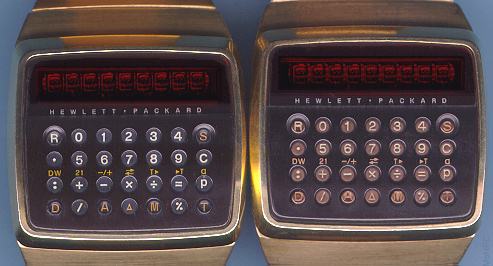
HP-01s in both gold and stainless steel can be found with bronze or black-colored buttons as shown in this comparison photo (27K) which shows a 1978 version on the left and a 1977 version on the right. See the HP-01 page for both versions in stainless steel. Earlier bracelets had links whose edges were polished to a mirror finish whereas later versions were brushed. Later versions added the legends "U.S. & Foreign Components" to the case back and "or plaque galvanique 10" to the bracelet clasp. Later gold versions omitted the gold plating from inside the clasp.
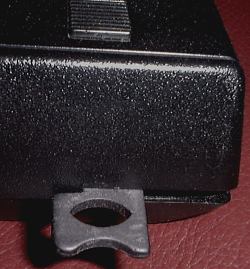
These calculators can be found with or without a security cable attachment bracket. The bracket is metal and pivots out from the back right corner.
On some versions, the keypad was metallic and had a smooth finish with metallic gold or silver trim. On other versions the keypad was plastic and the trim was light grey or light brown. The texture of the plastic keypads ranged from smooth to textured/matte.
The 30 series also had two very different construction techniques.
Early HP-41Cs used the same key shape used in the 20 and 30 series. Later HP-41Cs had lower keys with a gentler slope for the front (alpha) label. The exact colors, feel of the keyboard, and texture of the keypad vary somewhat over the calculator's long run. Later "Halfnut" versions had redesigned and simplified electronics. All HP-41s can be found in Halfnut versions although CVs and CXs are much more common than Cs.

Early HP-41Cs had gold-plated ball-bearings on the side of the battery compartment to allow for a future AC adaptor that was never produced. When HP introduced the rechargeable battery pack with its own charger connector, the ball bearings were omitted from the calculators
Early HP-41Cs had a number of bugs including not checking STO IND and RCL IND for proper range which allowed accessing system registers. The IND modifier also allowed out-of-range augments for flag operations.
The HP-41C Option 001 can be found with or without a piece of plastic that covers the USER and PRGM keys. Most are HP-41CVs internally but some are HP-41CXs. Some, but not all, Option 001s have halfnut electronics. Some Option 001 Models don't have serial numbers.
Versions can be found with the HP logo/model number in either highly reflective glossy silver or a matte-finished silver. Later models had painted rather than molded key legends.
Late versions of the HP-11C, 15C and 16C were made with HP-12C keys that were repainted. Some HP-16Cs had HP-12C keys that were first repainted to be HP-15C keys and then repainted to be HP-16C keys. The picture below shows an HP-16C "F" key over an HP-12C "CHS" key.

Early HP-11Cs had a bug in which if you entered a number in the form 0.0xxx, backspaced over all the digits and then pressed ENTER, 1.00 was entered rather than 0.00. HP allowed users of buggy calculators to swap for fixed units.
The HP-12C has undergone numerous small modifications in its long run.
Some versions have the display set deep and others are nearly flush with the top of the calculator.
Get them while you can! Supplies are dwindling. If you must repair a pack, be careful. You can injure yourself or damage your calculator.
There are several companies that can rebuild battery packs for you or you can make your own from scratch.
Most modern HPs use AAA, N, or LR44/SR44-type batteries. The later can be confusing because battery numbers vary by company. Some LR44/SR-44 equivalents include:
Compatible cells can be found in both alkaline and silver-oxide. The silver-oxides tend to last much longer on the shelf and in the calculator. (For example: LR44, A76 , EPX76 are alkaline but SR44, 357 and G13 are silver-oxide. Check the package to be sure.) Any photo, electronics or jewelry shop should be able to help you.
Numbers are in the format
YYWWC##### where
Example: The museum's HP-94F is serial number 2622J00025 indicating that it is the 25th unit made in Japan in the 22nd week of 1986.
The correspondence of serial numbers to dates is only approximate. In some cases, they may be better indicators of the date of manufacture of the case or label rather than the entire calculator. With some desktop models, it appears that the date code was changed only when there were manufacturing changes. On the other hand, different versions of the HP-35 can be found with the same date code. (The museum has examples of type 3 and 4 with date code 1346 and some of the type 4s have lower sequence numbers than the type 3s!)
Sometimes prototypes and test models fall into collectors hands with no serial numbers or serial numbers in another format. On HP 9825Bs, YY appears to be the number of years since 1970.
Since 1996, some serial numbers have been in the form
CCYWW##### where
These are the earliest date codes recorded so far for the various models. The date code is the first (left-most) four digits or first 5 characters for some post '96 models. Since this list was based on just a few hundred samples, you may have an earlier date code. If so, please send it to the museum for inclusion here. Note that some models make it easy for serial numbers to be swapped so these numbers must be regarded with some suspicion.
HP-01 |
1707 1701 2849 2116 2033 2142 2814 2230 2221 2809 3004 2561 2801 3008 1707 2832 1504 2917 1510 2830 1509 1608 1602 2752 2611 2801 1703 |
HP-31E |
1814 1826 2821 3112 2010 1831 1928 1143 1143 1302 1346* 1850 2006 1826 3524 1930 2103** 2338 2832 1301 1314 3303*5 3303*5 3107 3003 1447 1333 1609 |
HP-70 |
1431 2402 2249 2436 1247 1332 2010 2120 2452 2215 2349 1606 1708 2633*** 2625 2622 Pilot #1 1612 1803 2414 0938 1304 1128 1529 1144 1622 1014**** 1144 |
Notes:
| * | See Variations and Special Models above or the HP-35 exhibit for HP-35 types. One Type 4 with a 1143 code exists but this was probably a serial number swap. Another Type 4 has been found with a date code of 1249 but its back has clearly been removed so it may be another swap. |
| ** | Earliest Halfnut version found: 2541. |
| *** | The earliest HP-94D recorded starts with 9990 but that's a prototype code. |
| **** | HP-9825B's used a different numbering system. |
| *5 | Also marked "PROTO". (3324 is the lowest seen non "PROTO" date code.) |
Many collectors want advice on how to build a collection that is interesting/proper/important without simply buying every model ever made. Each person must really make their own choice on what to collect but here are a few ideas for your consideration:
This is for the collector more interested in the packaging and underlying technology of calculators than the exact function set. You would start with the HP 9100 with its core memory, CRT, discrete circuitry and true tank-like construction, followed by one of the HP 9810/20/30 (chips & LEDs), followed by one of the 34/45/65/55/70/80/67, one of the 20 series, one of the 90 series etc...
Simply start from the beginning and work forward to the point of your choice. Many collectors find the earlier models more interesting because some later models are repackaging of earlier functionality. Some collectors avoid LCD models since they are newer and (in theory) have a more limited life.
Some collect only the desktops because they're the "real machines"/"Big Iron"/etc., because so many features appeared there first or because it's a thrill to own a collection of machines that cost thousands of dollars each when they were new. On the other hand some collect only handhelds because they're more obtainable, take less room to store or were meant for individuals rather than organizations. There are some crossover products, so to be complete both handheld-only and desktop-only collections should include the HP-46, HP-81 and HP-97S. (The HP-94 is purely a handheld even though its software was developed on another computer.) Note too, that most collectors consider the 90 series to be handhelds even though they're rarely used that way.
If you want to collect just the most "significant" models, here are some you should have: HP 9100A (first of all, first programmable, first card reader, first multi-line display, first expandable... etc. etc.), HP 9810 (first chips, first option ROMs, first LEDs and more), HP 9820 (first algebraic - you can skip if you dread "the other system"), HP-35 (first handheld), HP-80 (first business, the beginning of solvers), HP-81 (first use of '.' to address beyond 10 registers), HP-65 (first programmable, first pocket calculator with mass storage, etc.), HP-9825 (first "live keyboard", first true HPL), HP-25C (first continuous memory), HP-27 (business, stat, science in one small package) HP-10 (HP's only adding machine), HP-01 (not just HP's only watch - time and dates as data types), HP-34C (integration/solver), HP-41C (alphanumeric, expansion and I/O now in a handheld), HP-16C (the only one for computer scientists), HP-75C (first portable with BASIC), HP-94 (first backlit LCD, first built-in serial port, first x86 compatible), HP-28C/S (first RPL and first directories on the HP-28S), and HP-48SX expandable RPL, HP-32SII (fractions), HP-95LX (first pocket PC compatible).
Prices can vary by factors of more than 100 from the cheap to ultra expensive end of the scales. One dealer claims to make nearly $30,000 per month reselling items on eBay.
In 1997, the museum picked up extra copies of the relatively rare HP-10C, 31E, 65, 70 and 94D (and several common models) all in excellent or better condition and all for $20 or less. A recent local sale had over a hundred HP-41C modules and options priced at "4 for a dollar". The recently added Friden 132 was picked up for free two weeks after one like it sold for several hundred dollars on eBay. Calculator collecting can still be a low-budget hobby. The trick is to find dealers who haven't seen eBay yet. They're still plentiful but the word is spreading fast so hurry!
In 1999, one collector reported buying (over a 6 month period) several HP 41's, an HP-38C, 37E, 35, 45, a complete boxed HP-97 and, most recently, an HP-91 with manual. All were purchased at thrift stores for under $10. In 1998, he purchased an HP-70 with manual and multiple accessory books for $2.99. Legwork can still pay off.
It's easiest to buy a calculator locally where you can check it over first. If you are buying at a distance, here are some guidelines.
Yes, that's a lot of questions but in any collectibles field, its the more advanced collectors who ask the most questions and end up with the best samples. Of course, you'll rarely get positive answers to all the questions above.
EduCalc's HP-41, HP-71, and HP-75 stock is now being cleared out by Interfab: phone (949) 582-2631, fax (949) 582-1445. The items are so reasonably priced that some of them are showing up on eBay and selling to 5-10 times as much. Get them while you can!
For older manuals or copies, try the above or try HP at: (800) 227-8164.
Rechargeable battery packs are becoming difficult to find. There are several companies that can rebuild battery packs for you or you can make your own from scratch.
For other items, please read or post a message in the Museum Classified Ads or in comp.sys.handhelds.
 Go
back to the main exhibit hall
Go
back to the main exhibit hall