 The Museum of HP Calculators
The Museum of HP Calculators
The HP-18C was a business calculator with a new clamshell (folding) design and a dedicated alphanumeric keyboard. It was HP's first algebraic pocket calculator. (HP previously used algebraic logic on desktop calculators, portable and desktop computers and the HP-01 calculator watch.) Besides the basic business features of time value of money, cash flows etc., it had a clock with appointments, and an equation solver. It had 4 numbered registers, plus named lists.
It was also the first calculator to be programmed by HP in the new RPL language, however, this language was not made available to users of the calculator. The calculator was based on a Saturn architecture CPU.
The calculator used algebraic logic with parentheses (but no precedence) and the display showed what was happening at all times. (For example: 5x(2+3 would show on the display until the ) was pressed which would leave 5x5 on the display.)
Though it was an algebraic machine, it had a four level "history stack" with roll up and roll down keys. The LAST key retrieved the value on the next level of the stack into the current expression.
This was the first model to offer infrared printing. This saved the user from having to deal with wires and connectors (and was probably more reliable in the long term than tiny connectors.)
This was the first calculator to feature soft keys that were labeled by the calculator itself rather than written on cards or overlays. The calculator used a high resolution dot matrix LCD display to achieve this. The keyboard was rather sparse because many functions were moved to menus.
The solver allowed equations to be stored and solved for any variable. Equations
could be named, and once they were entered, the solver showed their variables
on soft-keys allowing these equations to be solved the way Time Value of
Money problems were solved on earlier business models. The number of equations
and the number of variables was limited only by total memory. The solver
provided all the functions of the calculator for defining equations plus
a few more features, the most important of which was conditionals. Conditionals
were embedded in expressions like:
IF(conditional_expression:true_expression:false_expression).
Besides relational functions, AND, OR, XOR and NOT could be used in the
conditional expression and IFs could be nested.)
The solver worked by first attempting algebraic manipulation on the equation to isolate the unknown variable. If this was successful, it calculated and displayed the result. If the isolation method failed, it used an iterative numerical approach to make the equation equal starting with either the user's guesses or its own.
 Saturn Architecture
 Dimensions
and Weight
Dimensions
and Weight
Price: $175.
Introduction-Discontinuation: 1986-1988
 Go
back to the main exhibit hall
Go
back to the main exhibit hall
 Next Calculator Made
 Previous
Calculator Made
Previous
Calculator Made
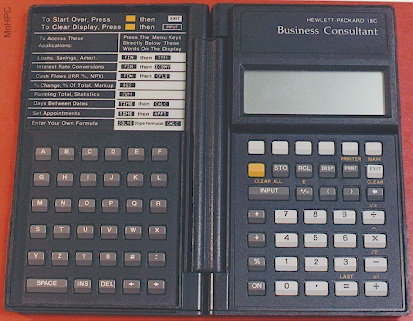 Picture of an HP-18C (~70K)
 HP-18C features
 Manual Available