 The Museum of HP Calculators
30 Series Technology And Packaging
A Whole New Way Of Building Calculators
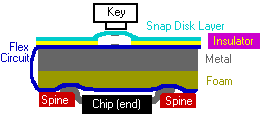
For the 30 series, HP designed an entirely new way of
assembling their calculators. Behind the keyboard was
a thick sheet of metal. On the back of this sheet was a foam pad and
a single flexible circuit was wrapped around the metal/foam
board. In front, an insulating sheet with holes for key contacts
was placed over the flexible circuit and a snap disk contact sheet was
placed over that and spot welded into place. (The welds made contact
between the snap disk contact traces and the main flexible circuit.)
The flexible circuit wrapped around the metal and was attached to the
foam in back.
A hard plastic backbone held the chips in place on the flexible
circuit with the foam supplying pressure against the circuit
under the chip leads. The chips were NOT soldered to the
circuit!
This arrangement was quite easy to assemble and also gave
the 30 series keyboard a level of rigidity even greater than
that of the 20 series while still making keyboard repairs
easy as on the Classic series. (The 20 series heatstaking made
keyboard repairs difficult.)
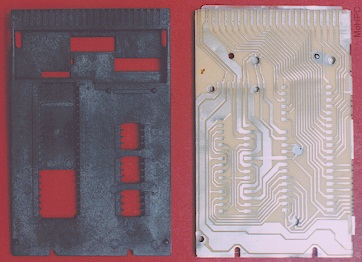
 Picture of the back of the main board showing
the flexible circuit over foam. To the left is the empty spine with the
circuit side up. (~40K)
Picture of the back of the main board showing
the flexible circuit over foam. To the left is the empty spine with the
circuit side up. (~40K)
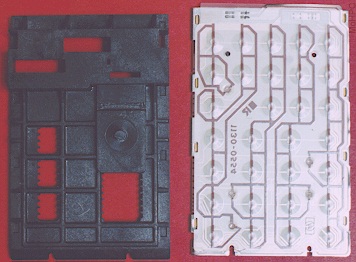
Picture of the front of the main board showing
the flexible circuit key pads over metal, with the snap disk layer on top.
To the left is the empty spine with the
circuit side down. (~38K)
Back To What Worked Before
Unfortunately, the original design didn't measure up to the reliability
of earlier HP calculators so HP redesigned the 30 series interior.
The redesigned models used
a more conventional design with a single rigid circuit board with snap disks
on one side and ICs soldered in place on the other side. A plastic
spine provided extra rigidity but didn't hold the chips in place as
on the earlier version. These later models weigh about 1.5 oz less due to
the removal of the metal sheet.
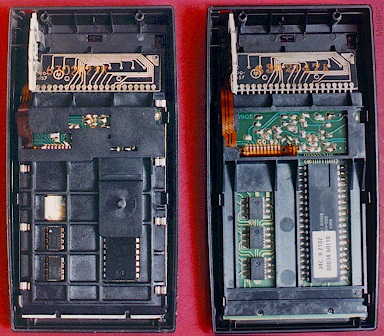
Picture comparing early (flex circuit) and late
(rigid circuit) series 30 calculators. On the older model (left) the spine
actually held the chips in place. In the later model, the chips were
soldered in place. Also note the metal retainers along the sides of the
early version which were essential to providing sufficient pressure on
the chip leads. (~80K)
Picture of the front of the new main board showing
the integrated snap disks. (~45K)
Display
The series series improved the display by increasing the digit size and
adding commas. In addition, the display was angled to be more readable
on a desktop.
Battery
The 30 series returned to using a separate battery and battery door.
The curator considers this a shame as the 20 series pack seemed so
clever. Collectors are often annoyed to find 30 series
models without battery doors because without a battery in place, the
doors fall
off rather easily. Another flexible circuit was used to connect the battery
terminals to the calculator circuitry. A "Bright Metal Alloy" replaced
gold for contacts.
 Go back to the main exhibit hall
 Picture of the back of the main board showing
the flexible circuit over foam. To the left is the empty spine with the
circuit side up. (~40K)
Picture of the back of the main board showing
the flexible circuit over foam. To the left is the empty spine with the
circuit side up. (~40K)
 Picture of the front of the main board showing
the flexible circuit key pads over metal, with the snap disk layer on top.
To the left is the empty spine with the
circuit side down. (~38K)
Picture of the front of the main board showing
the flexible circuit key pads over metal, with the snap disk layer on top.
To the left is the empty spine with the
circuit side down. (~38K)
 Picture comparing early (flex circuit) and late
(rigid circuit) series 30 calculators. On the older model (left) the spine
actually held the chips in place. In the later model, the chips were
soldered in place. Also note the metal retainers along the sides of the
early version which were essential to providing sufficient pressure on
the chip leads. (~80K)
Picture comparing early (flex circuit) and late
(rigid circuit) series 30 calculators. On the older model (left) the spine
actually held the chips in place. In the later model, the chips were
soldered in place. Also note the metal retainers along the sides of the
early version which were essential to providing sufficient pressure on
the chip leads. (~80K)
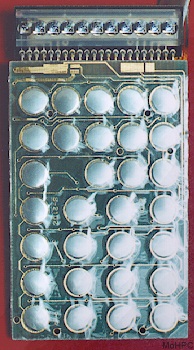 Picture of the front of the new main board showing
the integrated snap disks. (~45K)
Picture of the front of the new main board showing
the integrated snap disks. (~45K)