 The Museum of HP Calculators
The Museum of HP Calculators
The HP-35 was HP's first pocket calculator. It was introduced at a time when most calculators had only the four basic functions. The HP-35 was the first pocket calculator with transcendental functions, and the first with RPN. HP didn't know how large the demand for this calculator would be, as a result, they later had to warn people to expect waiting lists in the Hewlett-Packard Journal. The early models said only Hewlett Packard on the face plate. "35" was added to later models.
The 35 is well-known for having an x^y key instead of y^x. This makes a lot of sense on the 35 since it didn't have a 10^x key. If you wanted the anti-log of a number in x, you entered 10 x^y.
The 35 had no true shift key. It did have an "arc" key which inverted the sin, cos, and tan keys. The true shift key was first introduced on the HP-80 business calculator.
This was probably the only HP pocket calculator with a clear everything key. It was prominently located in the upper right corner and probably made adding machine users feel comfortable. This feature was dropped from the HP-45.
The HP-35 allowed the user to press the CHS sign before or during number entry. If a number was in the display as a result of something other than digit entry, pressing CHS negated it, but if the CHS key was then followed by a digit, the calculator assumed the CHS was actually meant for the following entry. Thus the previous number displayed was pushed onto the stack without the (already displayed) sign change. This feature could be confusing and later models required the CHS key to be pressed after the first digit of a number.
While thorough, the manual is about the size of the quick reference book for a modern high-end calculator.
From the inside cover:
"HP has now become an acknowledged leader in the field of computational problem solving. Over 10,000 HP programmable calculators and more than 3000 HP digital computers are at work in a wide range of scientific, industrial, and educational applications."...
"Now we've coupled our experience in scientific problem solving to bring you a new dimension in personal computing - - the HP-35 Pocket Calculator."
From the Foreword:
"To give you more computing power, your HP-35 works in a consistent and natural way that may be slightly different from previous calculators you have operated."
From the next section: Shirt Pocket Power
"Our object in developing the HP-35 was to give you a high precision portable electronic slide rule. We thought you'd like to have something only fictional heroes like James Bond, Walter Mitty or Dick Tracy are supposed to own.The HP-35 has far more computational power than previous pocket calculators. Its ten digit accuracy exceeds the precision to which most of the physical constants of the universe are known. It will handle numbers as small as 10^-99 and up to 10^99 and automatically places the decimal point for you. It is the first pocket calculator to provide you with transcendental functions like logarithms and sines and cosines. The operational stack and the reverse "Polish" (Lukasiewicz) notation used in the HP-35 are the most efficient way known to computer science for evaluating mathematical expressions.
The HP-35 was designed with you, the user, in mind. We spent as much time on the keyboard layout, on the choice of functions, and on the styling as we did on the electronics."
The reference to 10,000 HP programmable calculators refers to much more expensive desktop units that HP started making in 1967. The manual also explains the accuracy limits and includes a flow chart for applying RPN to any expression.
The early HP's were built tough and built to be repaired. After removing about a dozen screws you can get to anything in the HP-35.
At the time, many of the companies producing calculators could build adequate circuits and firmware, but didn't have the experience or facilities to make a well designed housing, keyboard, and display. Many of these brand-X machines were very failure-prone and quite crude in design.
By contrast, the packaging of the HP-35 was of major importance. It's size, looks, keyboard, and display were all carefully thought out. The keyboard is divided into groups with different sizes, color and placement of nomenclature. Even differing amounts of contrast were used to separate groups. (The most used groups had the greatest contrast level.) The keyboard panel used an HP-developed spring contact which is essentially unchanged in current calculators. The case had sculpted sides, such that the top caught the light and the bottom was in shadow making the calculator look thinner than it really was. All screws were hidden.
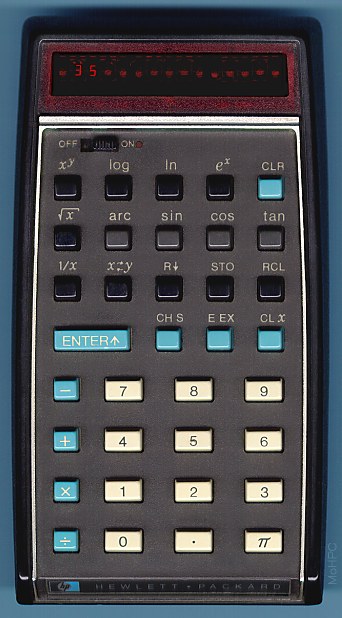 Picture of the first version of the HP-35 (~56K) This version
had a red dot to the right of the power switch that showed when it is turned
on.
Picture of the first version of the HP-35 (~56K) This version
had a red dot to the right of the power switch that showed when it is turned
on.
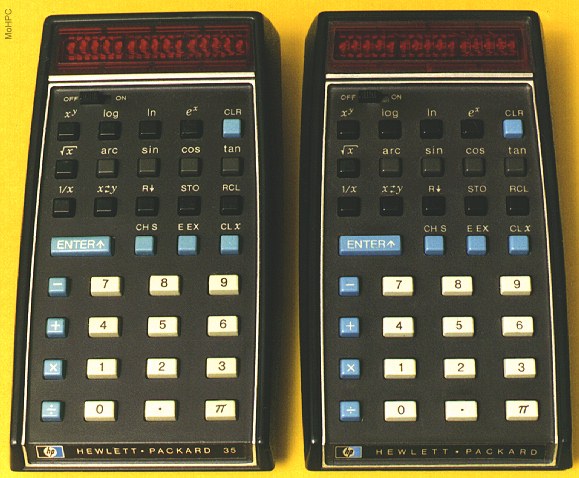 Picture of the middle two HP-35 versions (~76K) These versions
omitted the red dot. The newer version on the left added "35" to the label
at the bottom.
Picture of the middle two HP-35 versions (~76K) These versions
omitted the red dot. The newer version on the left added "35" to the label
at the bottom.
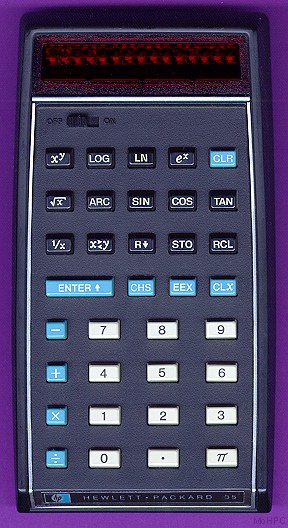 Picture of the last version of the HP-35 (~55K) This version
had all key legends molded into the keys themselves rather than printed on
the surrounding keypad.
Picture of the last version of the HP-35 (~55K) This version
had all key legends molded into the keys themselves rather than printed on
the surrounding keypad.
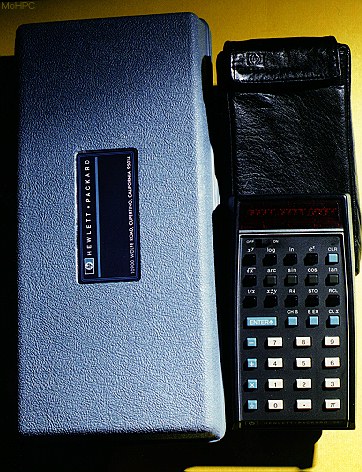 Picture of HP-35 with leather case and travel case
(~75K)
Picture of HP-35 with leather case and travel case
(~75K)
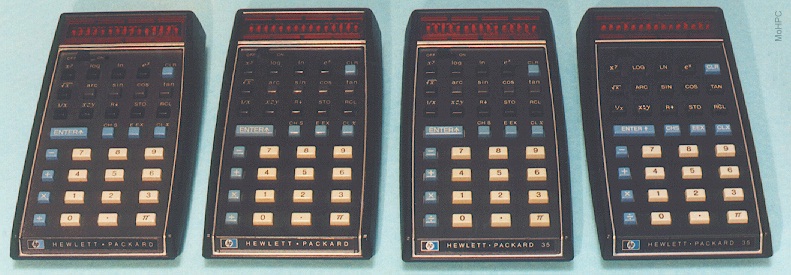 Picture of the all four versions of the HP-35 (~200K) Shown
in order from left to right.
Picture of the all four versions of the HP-35 (~200K) Shown
in order from left to right.
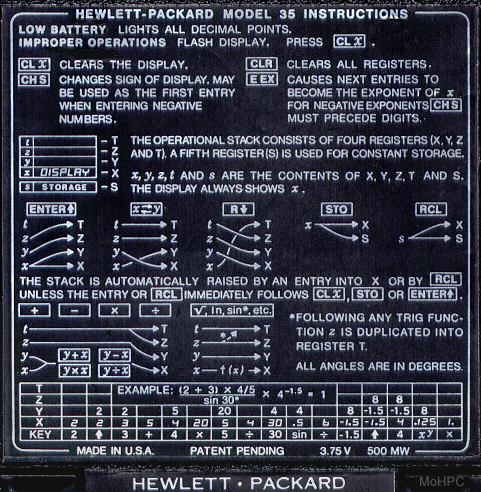 Picture of a back label in English (~78K)
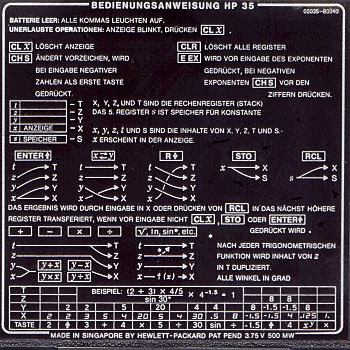 Picture of a back label in German (~48K) Image by David
Jobusch.
Picture of a back label in German (~48K) Image by David
Jobusch.
Price: $395 at introduction, reduced to $295 when the HP-45 was introduced.
Introduction-Discontinuation: 1972-1975
 Go
back to the main exhibit hall
Go
back to the main exhibit hall
 Next
Calculator Made
Next
Calculator Made
 Last (high end) Calculator Listed
 Dimensions
and Weight
Dimensions
and Weight Manual Available
 HP-35 features
 Technology