 The Museum of HP Calculators
The Museum of HP Calculators
Also used in the HP-10, HP-19C, HP-67, HP-91, HP-92, and HP-97/97S.
The heart of the 20 series calculators as well as many pocket calculators that followed was the Arithmetic, Control and Timing chip (ACT). This chip integrated the earlier generation's register, arithmetic, control, and clock driver circuit into a single package reducing size and cost.
The ACT chip had 8 56 bit data registers, an address register, two return address registers, 16 flags, and a 4 bit display format register. The chip could directly address 4096 instructions with its 12 bit address space. Because there was now one more register on the chip, trig calculations no longer overwrote the top of the stack as they did on the HP-35. The arithmetic unit was now capable of hexadecimal as well as decimal arithmetic. The processor could perform about 3000 instructions per second.
In addition, models other than the HP-21 had a data storage chip. This allowed more than a single storage register, and in the case of the HP-25 and HP-29C, program storage.
To reduce the size, the number of digits in the display was reduced from 15 digits to 12 and the exponent shared space with the mantissa. Another reduction in size was realized by combining the decimal point with a digit display rather than giving it a separate position of its own.
To reduce the size and weight, the 20 series used two rechargeable cells instead of the previous three. This 2.5 volt supply was converted to 4 volts to operate the display. The battery pack was ingeniously designed as a single unit that snapped into the back of the calculator. There was no need for a door or any latches, the battery pack was held in place by the same spring that kept the batteries in contact with the calculator terminals. (These terminals were now soldered directly to the PC board removing the need for hand-wiring.)
HP was able to reduce size, cost, weight and at the same time increase the rigidity of the calculator by careful package design and by using heat stakes to attach the keyboard circuit to the face plate. There was no need for a "backbone" as there was in the earlier machines. The number of screws dropped from 12 to 2.
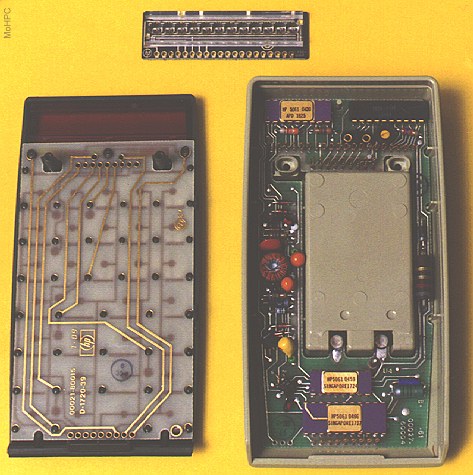 Picture of the interior of an HP-27 showing
the back of the keyboard (heat-staked to keypad), LED display module and
main circuit board laying in the bottom of the case. The large area in the
middle is the battery compartment. (~71K)
Picture of the interior of an HP-27 showing
the back of the keyboard (heat-staked to keypad), LED display module and
main circuit board laying in the bottom of the case. The large area in the
middle is the battery compartment. (~71K)
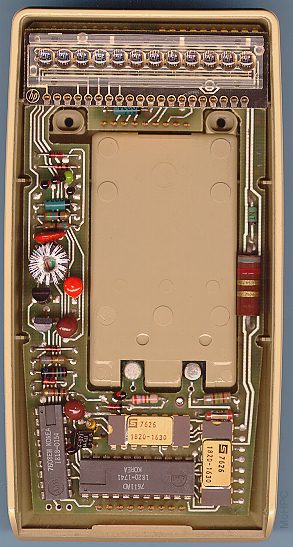 Picture of the interior of an HP-25C. Similar to the right
side of the picture above but with the LED module still attached to the main
circuit board. (~51K)
Picture of the interior of an HP-25C. Similar to the right
side of the picture above but with the LED module still attached to the main
circuit board. (~51K)
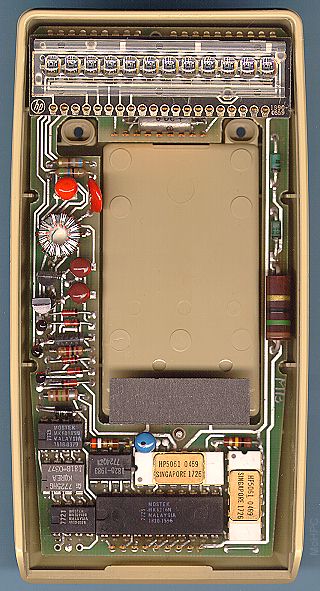 Picture of the interior of an HP-29C. (~61K)
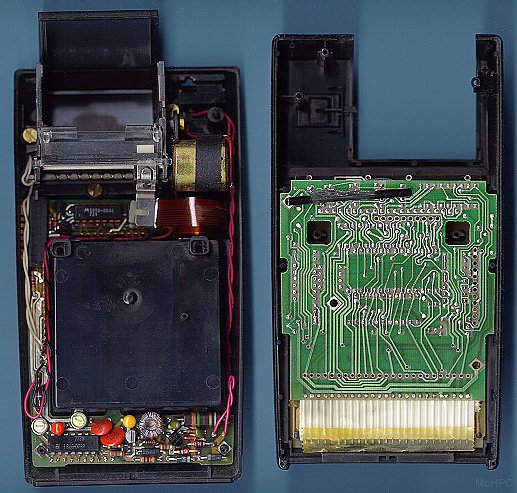 Picture of the interior of an HP-19C. (~86K) Many components
are on the back side of the main circuit board on the right.
Picture of the interior of an HP-19C. (~86K) Many components
are on the back side of the main circuit board on the right.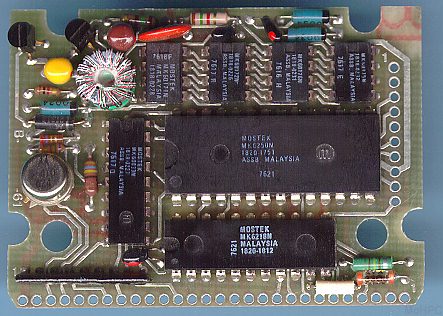 Picture of the interior of an HP-67 main circuit board.
(~51K)
Picture of the interior of an HP-67 main circuit board.
(~51K)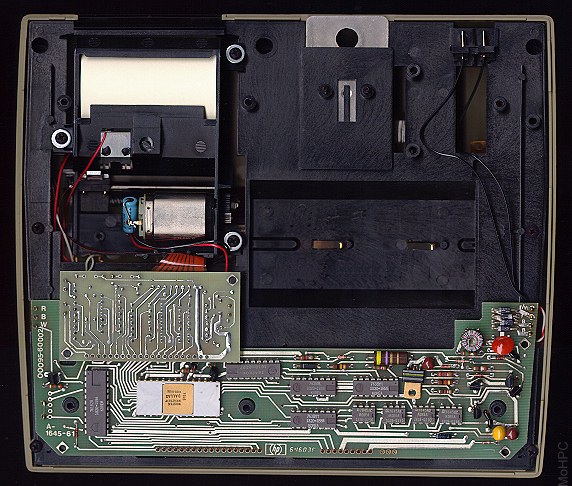 Picture of the interior of an HP-95C showing the back of
the main circuit board, printer and battery compartment. (~102K)
Picture of the interior of an HP-95C showing the back of
the main circuit board, printer and battery compartment. (~102K)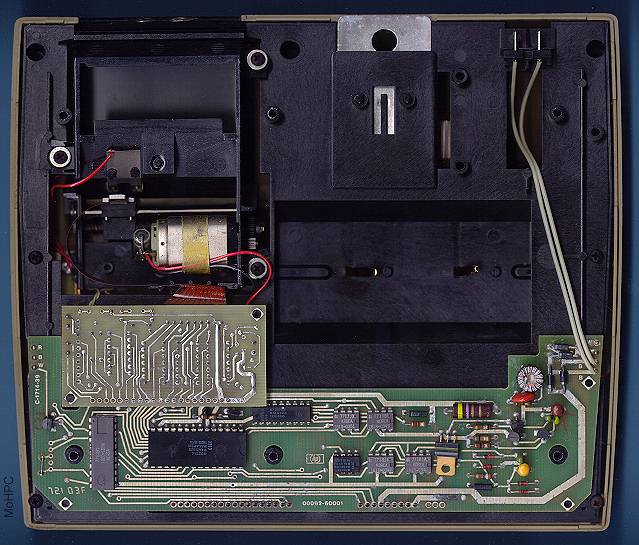 Picture of the interior of an HP-92 showing the back of the
main circuit board, printer and battery compartment. (~75K)
Picture of the interior of an HP-92 showing the back of the
main circuit board, printer and battery compartment. (~75K) 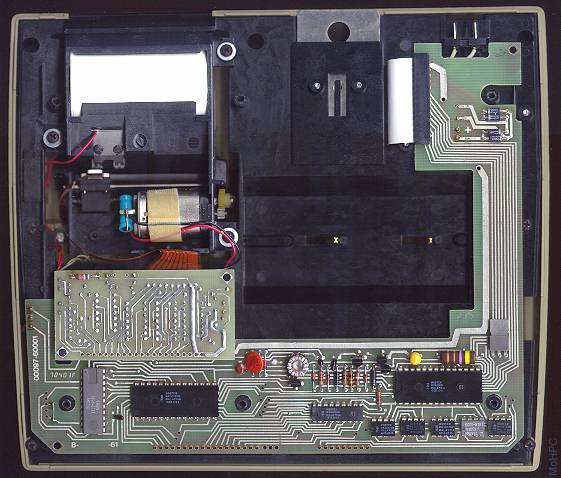 Picture of the interior of an early HP-97.
(~53K)
Picture of the interior of an early HP-97.
(~53K)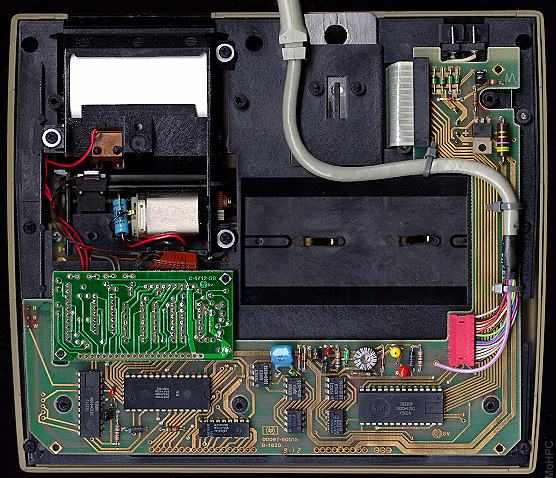 Picture of the interior of an HP-97S. (~81K)
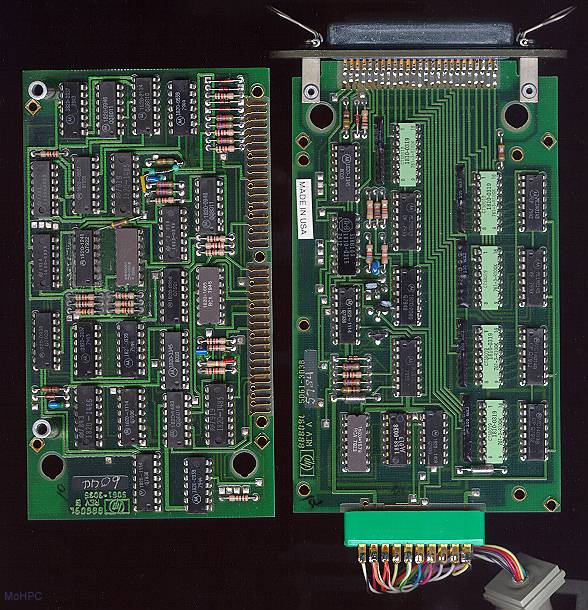 Picture of the two cards in the HP-97S BCD Interface pod.
(~92K)
Picture of the two cards in the HP-97S BCD Interface pod.
(~92K)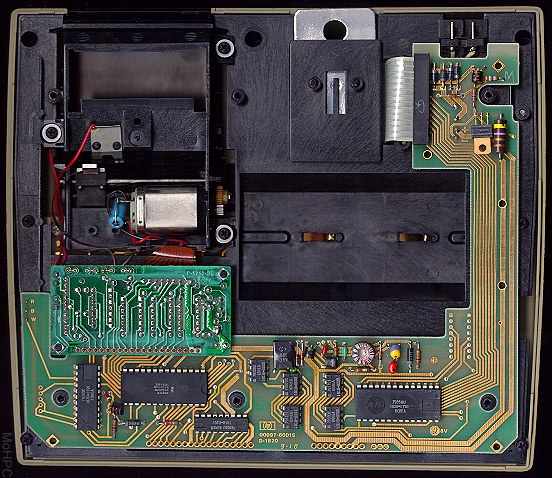 Picture of an HP-97 made after the introduction of the HP-97S.
It is Just like the HP-97S except for the connector & cable. The connector
pads are clearly visible on the lower right. (~118K)
Picture of an HP-97 made after the introduction of the HP-97S.
It is Just like the HP-97S except for the connector & cable. The connector
pads are clearly visible on the lower right. (~118K) Go back to the main exhibit hall