 The Museum of HP Calculators
Slide rules were analog devices in which the number of significant digits
were proportional to the size of the rule (and the smallest graduations that
a typical person could resolve.) By wrapping the scales around a circle,
the manufacturer could increase the scale length while keeping the overall
length modest. (But with an increase in width which made many
of them too large for pockets.)
Loga
The Loga slide rule shown below
was all metal except for the cursors. It was 5 inches
in diameter and had a pivoting stand on the bottom so the cursors and slide
could easily be moved while it was sitting on a desk. The black protrusion
on the left controlled the rotating portion (all but the two outermost
scales) and the
bottom cursor. The top cursor was positioned directly.
On this slide rule, the multiplication scales were labeled A and B
and the squaring scale was labeled n^2.
 Picture of a Loga circular slide rule (~70K)
Atlas
The Atlas slide rule shown below was also all metal, but instead of having
a rotating scale like the Loga, it used two pointers and a solid disk.
The top pointer moved freely by itself but moving the bottom pointer also
caused the top pointer to move. Another important difference is that while
the loga had multiple circular scales on the front, the Atlas had a single
spiral scale allowing much greater accuracy. (Trig. scales were on the back.)
The rule was 8.3" in diameter and was
copyrighted in 1931.
Picture of an Atlas circular slide rule (~138K)
Fowler
The Fowler's Calculator shown below
was a variation on the circular slide rule.
The entire scale disk was rotated by turning the top knob. No part of the scale
rotated with respect to another part. Instead, the second knob, rotated a
second hairline (in black) while the other (red) hairline was fixed relative
to the metal case. (This made it more like the Gunter's line with the
hairlines serving as dividers.)
To multiply 25x14, the user rotated the scale to align 25 with the
fixed red index. Next the user moved black index to 1.
The user then moved the scale to align 14 with the black index.
The result of 35 could be read from the fixed red index.
Once the decimal was positioned the result was 350. This could be
chained as needed and because it was circular, there was no need for
folded scales.
This calculator was 3.4" in diameter and ruggedly made for traveling.
(Though its thick metal case will get your carry-on luggage inspected
these days.) It came in a heavy duty felt lined leather case.
The model displayed is the "Fowler's Twelve-Ten" and was made around 1950.
Besides the typical
multiply and reciprocal scales, it included scales for converting
twelfths to/from tenths,
meters to yards, Kg to lbs, in to cm, etc. Many other models with different
scales were available and they came in sizes both larger and smaller than
the one pictured. Scales on the Fowler's were obviously labeled like
"recips" rather than the more common A, B...
Picture of the Fowler Calculator (~72K)
Lietz/Pickett
The Lietz circular slide rule shown below was smaller overall and
simpler in construction than the two above. It was 4.2" in diameter and
.05" thick over most of its surface (.4" thick at the center.)
It was just a single piece of metal with a single pointer on the back
and two pointers on the front. The back pointer aided reading
the scales C, S, ST and T. The front pointers were used
alone or together for the C, CI, A (decimal squares), Af (fractional squares),
L, Fa (fraction addition/subtraction), LL1, LL2, DS (drill size),
DT (double depth of threads) and
M (metric conversion) scales.
Multiplication was performed with both pointers using the C scale.
To multiply X by Y, the user set the lower pointer to X and held
it there while moving the upper pointer to 1. Then the user released
the lower pointer and moved the upper pointer to Y (which moved the lower
pointer to the result.) As always, division was simply the reverse.
Picture of the Lietz Slide Rule (~58K)
 Back to early models contents
 Go on to cylindrical slide rules
 Back to Large Rules, Complicated Rules & Sectors
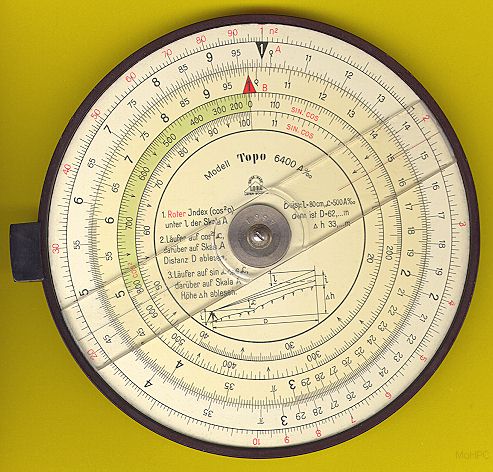 Picture of a Loga circular slide rule (~70K)
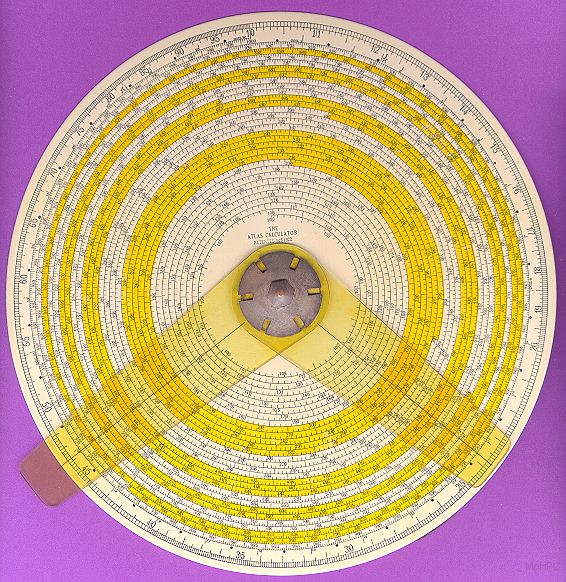 Picture of an Atlas circular slide rule (~138K)
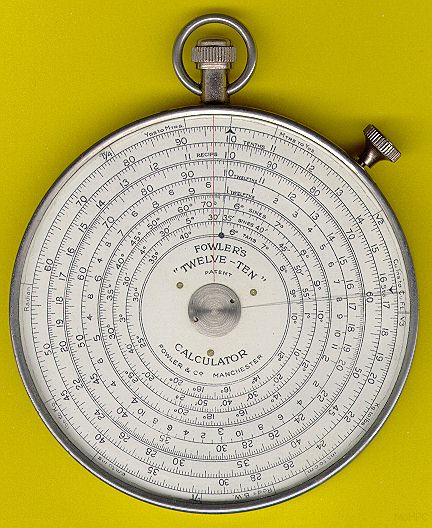 Picture of the Fowler Calculator (~72K)
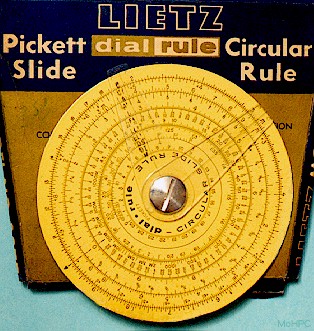 Picture of the Lietz Slide Rule (~58K)