I grew up in East Lansing Michigan USA, studied electrical and computer engineering at the University of Michigan in Ann Arbor, and am now living in Oregon. I've worked for Intel as a software engineer since graduation. I started at Intel by working on Real Time operating systems (iRMX 86, iRMX 88, iRMK, iRMX 386, etc.) and then wrote display drivers and applications such as ProShare Application Sharing for various versions of Windows. I currently manage a small lab working on speech applications and tools.
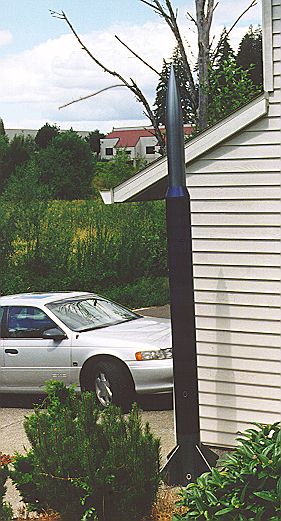
My other interests include science fiction (in general and Doctor Who specifically) photography and high power rocketry. (That rocket does fit in the car after being broken down.)
My fascination with HP Calculators began in 1972 when I came across one of Hewlett-Packard's "Some things are changing for the better" advertisements in Scientific American. It was a simple one-page black and white ad for the most amazing product I had ever seen. The text began with "When you first hear about it, it sounds like an electronic slide rule, the kind that's been available only in science fiction." It was an incredible device and it only cost $395.
There were just two problems:
At $3 a week, my HP was going take a while to acquire. This turned out for the best however, because as my savings slowly accumulated, HP came out with even more fantastic models. The HP-45 added to the features of the HP-35 and the HP-65 was simply unbelievable. (I'm still amazed that anyone had the audacity to put a motor-driven magnetic card reader in a pocket calculator - and in standard HP style, it even the sound it made was impressive.)
When the HP-25 was introduced in 1975 my savings and HP prices finally intersected. I used nearly my entire savings to buy it only to receive a letter from my grandfather the next day containing a check for half the price. He had seen an ad for the HP-25 and had independently concluded that it was the calculator for me. Obviously I was destined to own that calculator.
I loved the HP-25 and still do. Everything was perfect. The calculator was rock-solid, perfectly shaped for my hand and smaller than calculators with one tenth of its capabilities. The manual was also a joy. It started by having you enter a program before teaching the basics so you'd know right from the start how easy it was going to be. Story problems involving "lovesick sailor Oscar Odysseus" and the world's largest pizza assured that it never became monotonous.
I've been buying HPs ever since. In my senior year in high school I wrote a Star Trek program for my new HP-67 and from that point on, any time I needed my calculator, I had to hunt it down. (In my high school in 1976, if you wanted to program a "real computer" you punched cards and sent them off to be run at night only to find pages of error messages the next day.) My HPs got me through college in Ann Arbor Michigan and my HP-16C has been a trusty companion in my work.
A few years ago, I realized that I still felt that I had missed out on the HP-35 so I searched and finally found one in nearly new condition. Then I decided that the HP-65 was also a missed opportunity and I just had to have one of those too. And that timer feature of the HP-55 was pretty cool. (You can see where this is going can't you?)
In early 1995 I decided I wanted to learn a little about HTML so I decided to put my collection of early models on the web in the form of a museum because, well, no-one else had done it. I was deluged with email from fellow HP calculator lunatics who loved my museum but wanted to see more. What about the HP-41C? The 30 series? I gave in to the Internet masses and sought out every HP calculator made.
With the help of the Internet I managed to add calculators from Argentina, Norway, England, Australia and all over the U.S. to my local finds.
After building the Museum, I decided I wanted to do another site, so one of my other interests -- Doctor Who -- was selected. After looking around I saw that there were a great many Doctor Who sites and "yet another one" would be redundant, however, I didn't see anything at all on the net about Doctor Who toys. If you want to see something completely different than HP calculators, you are invited to visit The Skaro Toy Museum.